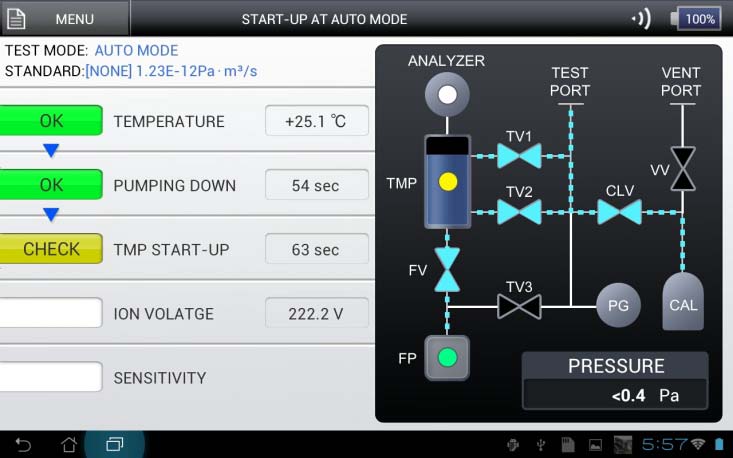
On-Site Commissioning for ULVAC HELIOT Leak Detectors
Commissioning is the process of installing a ULVAC HELIOT leak detector at a new location, verifying that it operates within specification, establishing its baseline calibration data, and training the operators who will use it. Correct initial commissioning is the single most important factor in long-term instrument reliability and data integrity. An instrument that is incorrectly installed, incorrectly calibrated, or used by undertrained operators will produce unreliable results regardless of its technical specification.
What On-Site Commissioning Covers
Installation Check
- Physical inspection for transport damage (external and internal)
- Power supply verification: voltage, frequency, fusing, earthing/grounding
- Instrument positioning: ventilation clearances, stability, floor levelness
- Inlet connection to test system: correct flange, clean installation, no contamination introduced during connection
- Exhaust line connection: adequate exhaust, no back-pressure
- External I/O cable connections (RS-232C, RS-485, EXT.I/O) if used
- Tablet controller charge, pairing, and wireless connectivity verification
Performance Verification
- First power-on and startup sequence observation
- Startup time measurement (<2 min specification on HELIOT 900 series)
- Pirani gauge readings: fore-line and analyser pressures at operational state
- Inlet blank-off pressure measurement
- Pump-down time from atmosphere to ULTRA flow mode
- Ion source emission current check
- Internal calibrated leak check and calibration factor recording
- Sensitivity verification with external traceable reference leak
- Response time and recovery time measurement
- All three test modes (ULTRA, FINE, GROSS) verified
- Sniffer mode if applicable
- EXT.I/O signal outputs verified at known leak rates (if PLC integration used)
Baseline Documentation
Commissioning produces a baseline record for the instrument covering all measurements above. This baseline is used at subsequent maintenance visits to detect changes in instrument performance over time. A new instrument with no baseline makes trend analysis at maintenance impossible.
Operator Training
All operators who will use the instrument receive practical training at commissioning:
- Instrument startup sequence and status display interpretation
- Test mode selection for the application (which mode and why)
- How to perform internal calibration and what the result means
- Setpoint configuration (SP1/SP2/SP3) for the application
- How to interpret PASS / FAIL results
- Correct probe usage if sniffer mode is used
- EXT.I/O interpretation if used
- Instrument shutdown procedure
- What to check if the instrument does not reach test mode (first-level fault check)
- How and when to contact us for service
Commissioning for Used or Relocated Instruments
If a HELIOT instrument has been purchased second-hand, relocated from another facility, or returned from storage, commissioning is strongly recommended before putting it back into service. Instruments in storage may have:
- Degraded pump oil requiring change before startup
- Ion source near end of life or already failed
- Internal calibrated leak within or near end of stated service life
- Outdated calibration data (calibration factor from previous installation may not apply)
- Unknown history if purchased second-hand
We carry out incoming inspection and recommissioning of used or relocated instruments and document instrument condition before and after service.
Documentation Provided at Commissioning
- Installation check record
- Performance measurement record (all baseline readings)
- External calibration record (reference leak data, date, temperature, readings, calibration factor)
- Operator training attendance record (if required by customer quality system)
- Recommended maintenance schedule and next service date
Request On-Site Commissioning
Email: mail@ulvacheliot.com
Please include: HELIOT model and serial number (from packaging or documentation if new), facility location, expected installation date, and whether the instrument is new, relocated, or second-hand. We will respond within 1–2 business days and advise on scheduling and scope.
Preventive Maintenance | Calibration | Operator Training | Repair