Helium Leak Testing — Comprehensive Technical Guide
Helium mass spectrometer leak testing is the most sensitive quantitative leak detection method available in industrial practice. This guide explains the physics, methods, terminology, and practical considerations for engineers using ULVAC HELIOT instruments.
Why Helium?
Helium is chosen as the tracer gas for leak testing for several fundamental reasons:
- Small atomic size — helium (atomic radius ~31 pm) passes through leaks more readily than larger molecules, giving a conservative (worst-case) measurement
- Inert and non-toxic — safe to use in enclosed spaces; does not react with test parts or surroundings
- Low background concentration — atmospheric helium is approximately 5.2 ppm, giving a stable and low baseline signal
- Mass spectrometer selectivity — helium has a unique mass-to-charge ratio (m/z = 4) that is clearly resolved from all other common atmospheric gases
- High diffusivity — helium diffuses rapidly through leaks, reducing test cycle times
How the HELIOT Instrument Works
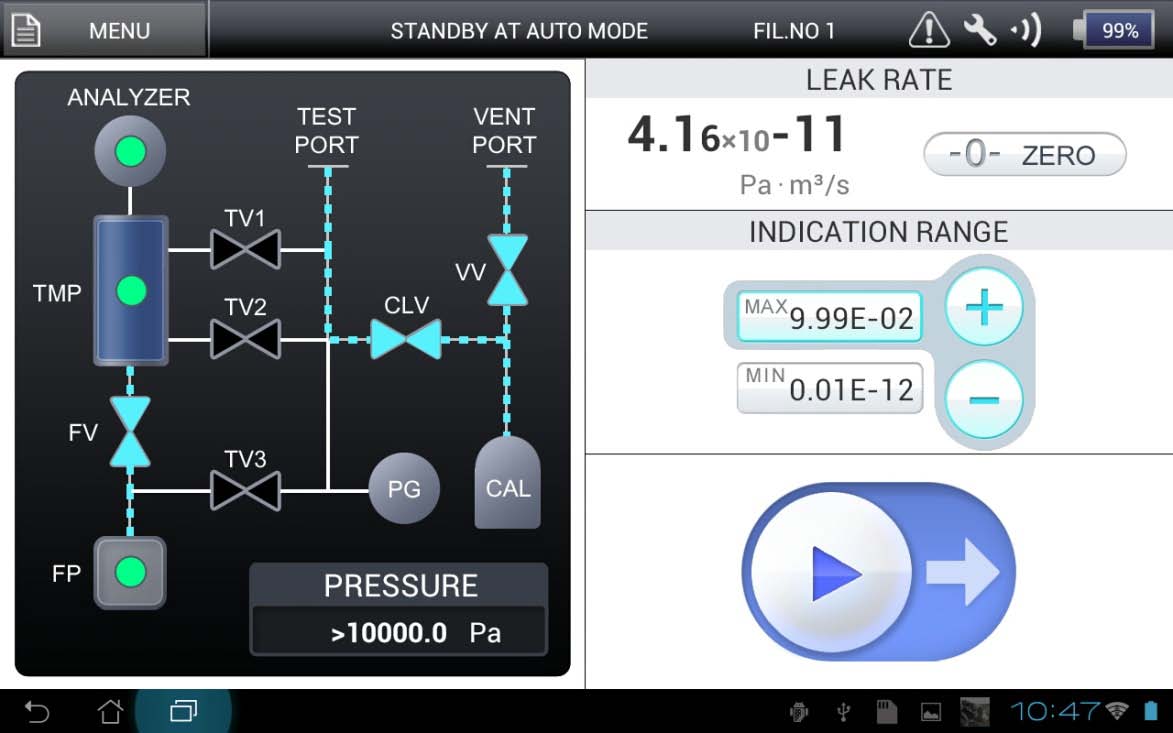
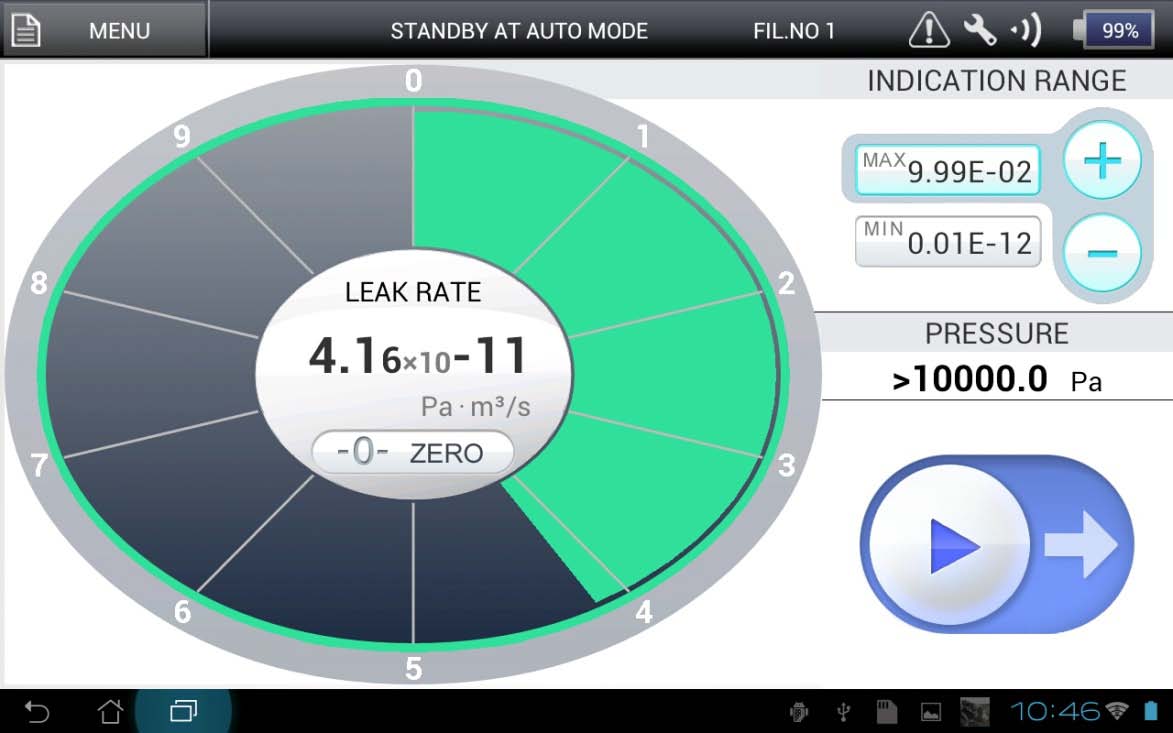
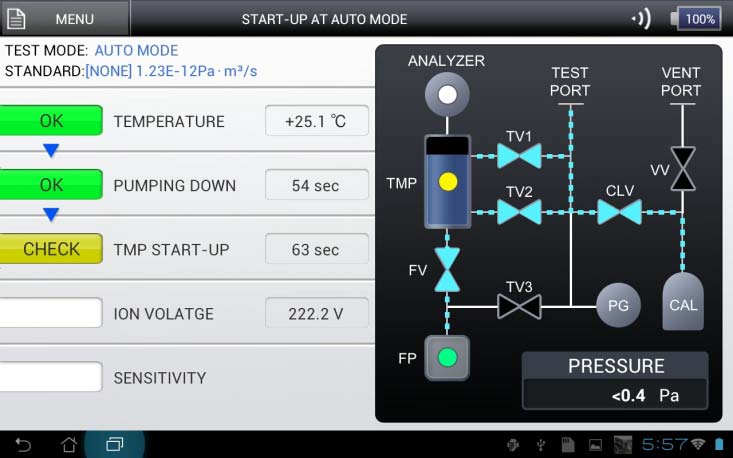
The ULVAC HELIOT series uses a 90° magnetic deflection mass spectrometer as its analyser. The vacuum circuit — shown live on the tablet controller — consists of:
- TMP — turbomolecular pump (maintains analyser vacuum)
- FP — fore pump (backing pump)
- FV — foreline valve
- TV1, TV2, TV3 — test valves (control gas flow path)
- CLV — counter-flow limiter valve
- PG — Pirani gauge (pressure measurement)
- CAL — internal calibration leak
- VV — vent valve
Test Methods
1. Hard Vacuum Test (Direct Connection)
The test part is connected directly to the test port of the HELIOT instrument. Helium is applied externally (by spraying or using an enclosure). Any helium entering through a leak is drawn into the vacuum system and detected.
- Sensitivity: up to 1 × 10⁻¹³ Pa·m³/s
- Best for: small, rigid parts with definable leak paths
- Limitations: test part must withstand vacuum applied by the instrument
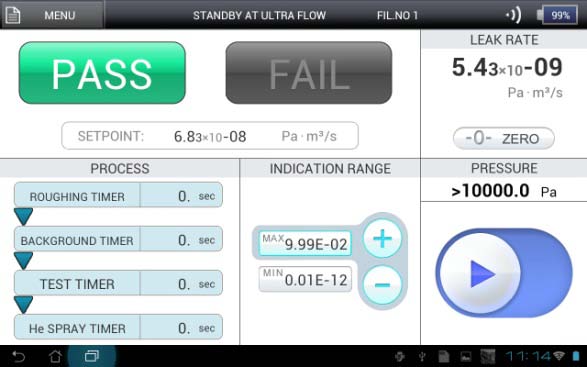
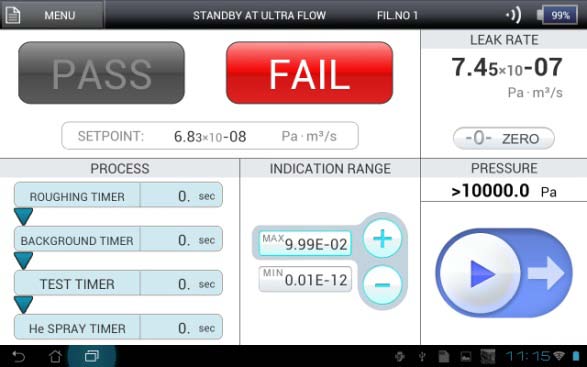
2. Ultra Flow Test Mode — PASS and FAIL
3. Ultra Fine Leak Mode
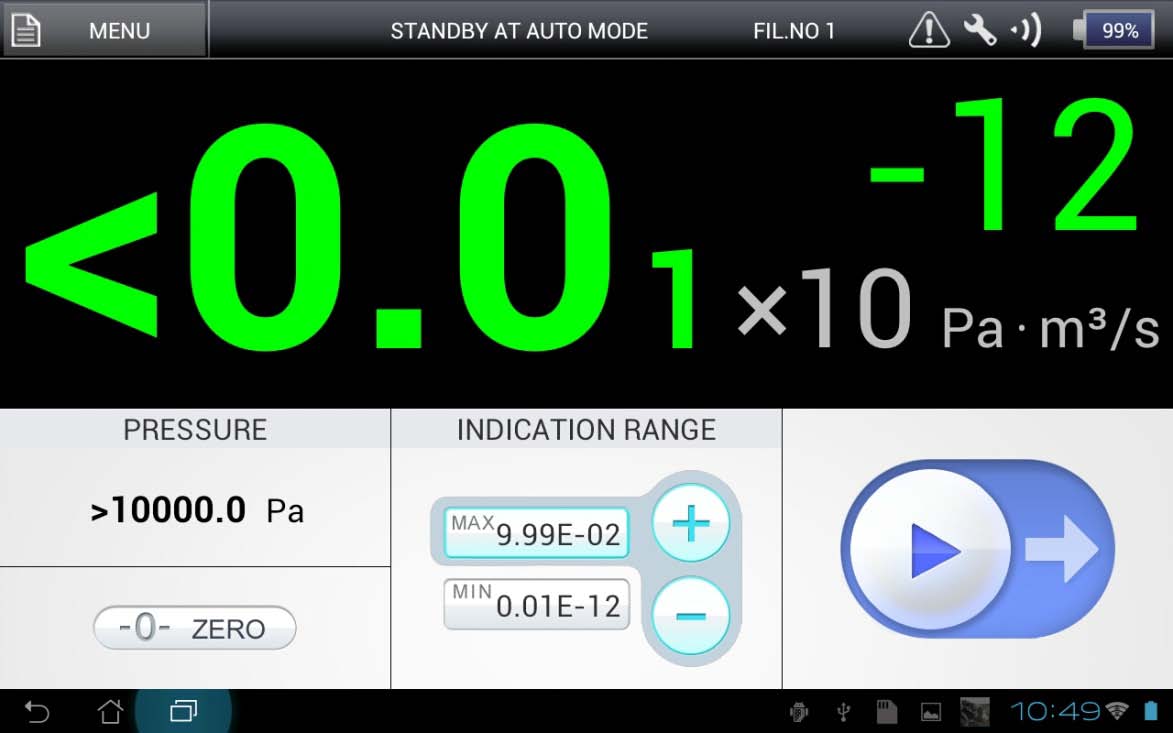
Ultra Fine Leak mode extends the measurement window and averages the signal for measurements near the instrument’s ultimate sensitivity limit. Appropriate for hermetic package testing where limits are below 10⁻¹² Pa·m³/s.
4. Sniffer Mode (Positive Pressure)
The test part is pressurised with helium or helium/air mixture. A sniffer probe connected to the HELIOT is swept over the surface to detect escaping helium. Sensitivity: 10⁻⁵ to 10⁻⁷ Pa·m³/s. Best for large assemblies that cannot be evacuated. After sniffer mode, helium background typically takes several minutes to clear — this is normal.
Startup Sequence
Calibration
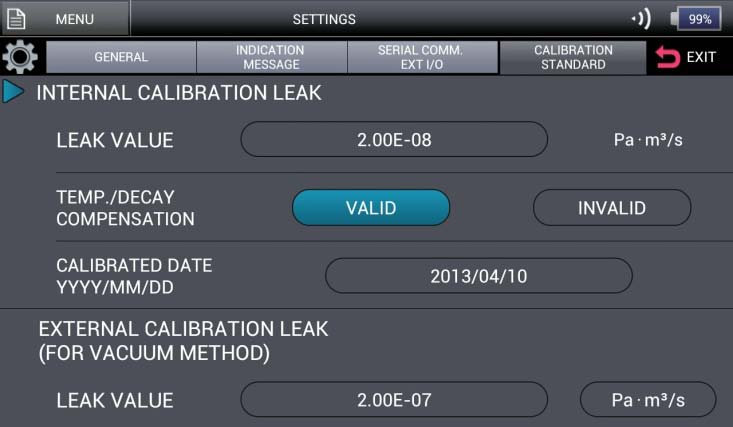
The HELIOT is calibrated using a calibration leak — a precisely characterised orifice producing a known leak rate of helium.
- Internal calibration leak — built into the instrument; activated from the tablet controller; value certified at manufacture
- External reference standard — a separate calibrated leak standard (CLM-08E, CLM-09E etc.) connected to the test port for periodic comparison and independent traceability
Leak Rate Units
| Unit | Equivalent | Common context |
|---|---|---|
| Pa·m³/s | — | SI unit; used by HELIOT instruments |
| mbar·L/s | = 0.1 Pa·m³/s | Common in European industry |
| atm·cc/s | ≈ 0.101 Pa·m³/s | Common in US defence standards |
| std cc/s | ≈ 0.101 Pa·m³/s | US semiconductor industry |
HELIOT 900 Sensitivity Range
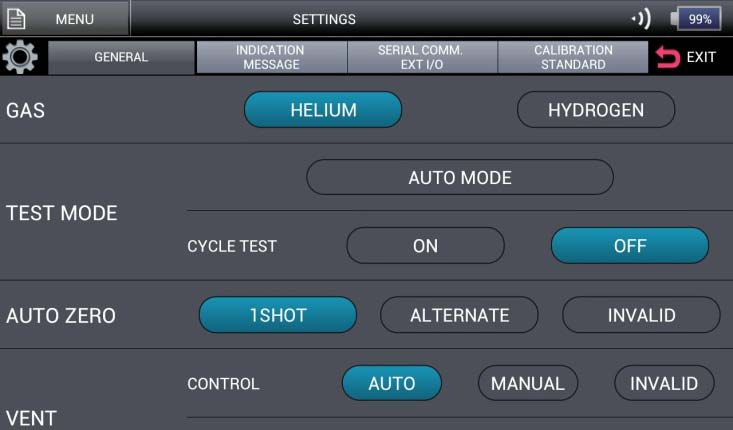
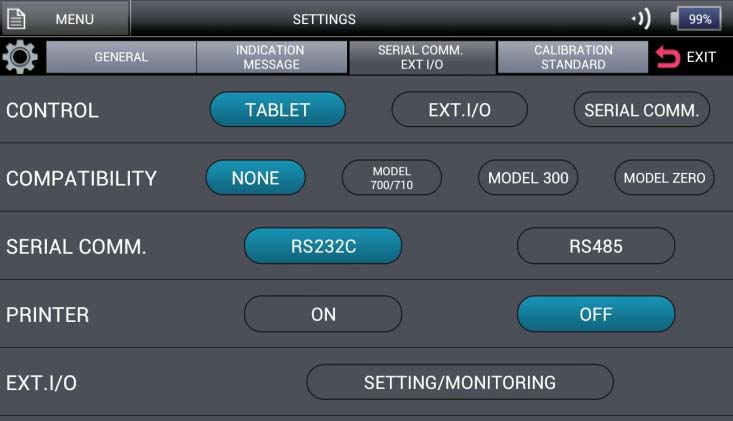
Test Mode Configuration
Common Issues and Solutions
| Symptom | Likely cause | Action |
|---|---|---|
| High baseline / elevated background | Helium contamination from recent sniffer use | Wait; run ZERO; vent briefly |
| Sensitivity loss | IS-BA1 wear; O-ring leak; TMP degradation | Contact us for service assessment |
| Slow response | Large dead volume; roughing pump performance | Minimise dead volume; check pump |
| Calibration drift | Internal leak age; temperature instability | Compare against external reference; contact us if >20% |
| TMP alarm | Bearing issue; power interruption during operation | Do not restart repeatedly; contact us |
Training and Support
We offer operator and technician training for ULVAC HELIOT instruments, covering: instrument principles, test method selection, setpoint configuration, calibration procedure, routine maintenance, and fault recognition. Training is conducted in English at your facility.
Training services | mail@ulvacheliot.com | Technical Library | ULVAC HELIOT Instruments