Frequently Asked Questions — ULVAC HELIOT Helium Leak Detectors
Answers to common questions about HELIOT operation, service, parts, and testing methods. If your question is not answered here, email mail@ulvacheliot.com.
Operation and Test Modes
Why does the HELIOT not reach ULTRA flow mode?
The most common causes: (1) test object is leaking too much air — the fore-line cannot reach the pressure needed for ULTRA flow; (2) gas ballast valve is open on the backing pump — this raises fore-line pressure and prevents ULTRA flow; (3) backing pump oil is degraded or level is low — pump cannot reach its ultimate pressure; (4) TMP is not at full speed — check for error code on tablet; (5) inlet valve or test connection has a large leak. Start by checking gas ballast and oil level.
What is the difference between ULTRA flow, FINE flow, and GROSS flow?
The three modes differ in which test valve is open, the maximum inlet pressure the instrument accepts, and the effective helium pumping speed. ULTRA flow: inlet pressure <2 Pa, best sensitivity, test object must be well-evacuated. FINE flow: inlet pressure <100 Pa, moderate sensitivity, for larger test volumes that take time to pump below 2 Pa. GROSS flow: inlet pressure <1,200 Pa, lowest sensitivity, for fast screening of large leaks. The HELIOT 900 transitions between modes automatically as the test object pumps down.
Can the HELIOT detect hydrogen instead of helium?
Yes. The HELIOT 900 series includes a hydrogen detection mode. Switch to hydrogen mode in the settings menu. Hydrogen (mass 2) is detected instead of helium (mass 4). Sensitivity in hydrogen mode is comparable to helium mode. Hydrogen has a greater atmospheric background than helium, which may affect the noise floor in poorly ventilated areas. Hydrogen is used where helium supply cost or cylinder handling is a concern.
What inlet port size does the HELIOT 900 have?
NW25 (KF25), conforming to ISO 2861. This is the standard connection for all HELIOT 900 series models. The inlet accepts NW25 centering rings and clamps. Adapters from NW25 to other sizes (NW16, NW40, NW50, NW100) can be used with appropriate conductance reduction considered.
How long does the HELIOT take to be ready for testing after startup?
The HELIOT 900 series typically reaches FINE flow mode within 3–5 minutes of startup, and ULTRA flow mode within 5–10 minutes, depending on ambient temperature and instrument condition. ULTRA flow requires the TMP to reach full speed and the analyser pressure to fall below the required threshold. Cold instruments (below 10°C ambient) may take longer.
Why does the leak rate reading drift upward when I apply helium near the inlet?
Background helium accumulation. Helium is lighter than air and accumulates near ceilings and in enclosed spaces. When helium is applied and some escapes into the test area, it builds up in the room air. The HELIOT detects this background helium as a slowly rising baseline. Good practice: ensure adequate room ventilation, apply helium sparingly, and always use the minimum flow rate needed to locate the leak. Allow background to settle before making a quantitative measurement.
Ion Source and Sensitivity
How long does the IS-BA1 ion source last?
Typical filament lifetime is 1,000–3,000 hours of instrument-on time, depending on operating pressure. The IS-BA1 has two filaments (A and B). Filament A is used first; when it breaks, the HELIOT automatically switches to filament B. When filament B breaks, the instrument shows an ion source fault and testing stops until the IS-BA1 is replaced. We recommend replacing the IS-BA1 when filament B activates, rather than waiting for the second failure.
Sensitivity has decreased — what should I check first?
Perform a calibration check first: open the internal calibrated leak and verify the HELIOT reads within ±30% of the calibrated leak value. If calibration has drifted: (1) check and recalibrate using the internal leak; (2) if internal calibration cannot bring the instrument within specification, the ion source may need replacement, the analyser may need cleaning, or the calibrated leak may be aged out. Contact us for a Analyser and Ion Source Service assessment.
Can I replace the IS-BA1 ion source myself?
Yes. The IS-BA1 is a cartridge-type ion source designed for field replacement without tools and without disassembly of the analyser. The procedure takes approximately 15 minutes. We provide remote guidance by email for first-time replacement. An ion source is supplied as part of our spare parts supply.
Calibration
How often should the HELIOT be calibrated?
Annual calibration using an external traceable calibrated leak (JCSS-traceable or equivalent national standard) is the standard recommendation for most applications. Some industries (aerospace, medical device) require calibration every 6 months. The internal calibrated leak should be verified at the start of each test day using the HELIOT’s built-in calibration routine. Internal calibration verification is not a substitute for annual external traceable calibration.
What is a traceable calibrated leak?
A calibrated leak with a certificate traceable to a national measurement standard (JCSS in Japan, UKAS in the UK, DAkkS in Germany, NIST in the USA, etc.). The certificate states the measured leak rate and its uncertainty at a defined temperature, with an unbroken chain of comparisons to primary standards. This is required when your test results need to be defensible in a regulatory, contractual, or quality audit context. We supply JCSS-traceable calibrated leaks and perform calibration with traceability certificates.
The HELIOT shows “CAL error” — what does this mean?
A calibration error typically means the measured value from the internal calibrated leak is more than 30% different from the stored calibration factor. Causes: ion source ageing (sensitivity drop); contaminated or ageing internal calibrated leak; large change in operating conditions. First, try performing a new calibration using the internal leak. If the error persists, contact us: the instrument likely needs ion source replacement or an external calibration service visit.
Maintenance and Service
How often should the backing pump oil be changed?
Annually, or more frequently if: the oil appears discoloured or milky (water contamination); the pump ultimate pressure has degraded; the instrument no longer reaches ULTRA flow mode; or the oil level has dropped below the minimum mark. Always use ULVOIL R-72 for HELIOT 901W1 and 904W2. Dry pump models (901D2, 904D3R, 904D4R) do not have oil in the primary pump and have different maintenance requirements. See Backing Pump Service.
Can you service HELIOT 710 series instruments?
Yes. We service all HELIOT generations including the 710 series (711W1, 714W2, 714D2, 714D3, 711D1). The 710 series uses the same IS-BA1 ion source as the 900 series. We supply calibrated leaks, filters, O-rings, and pump service for all 710 models. The 710 series is discontinued but fully serviceable — there is no need to replace a functional 710 instrument if it is correctly maintained and calibrated.
Do you provide on-site service outside Japan?
Yes. We work internationally. On-site visits for commissioning, calibration, and repair are available worldwide. Remote support by email is available to all countries. For on-site service, email mail@ulvacheliot.com with your location and the service required — we will provide availability and logistics information.
The instrument shows an error code I don’t recognise. What should I do?
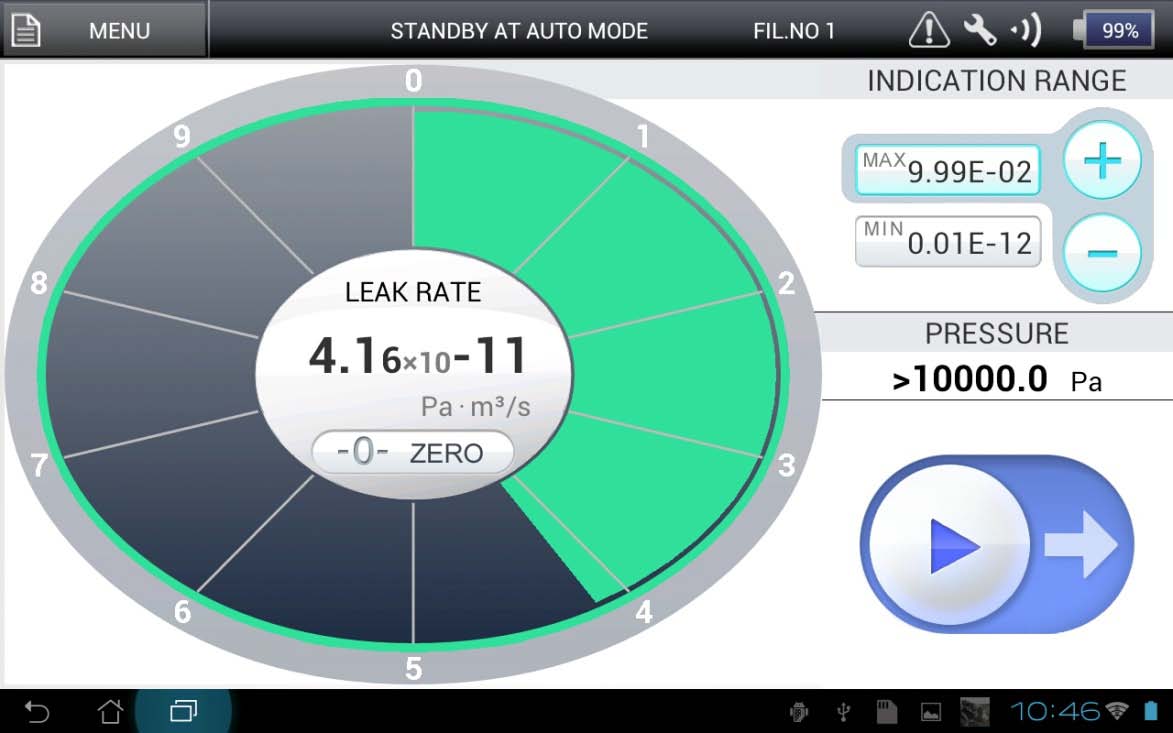
Take a photo of the tablet display showing the error code and any status indicators. Email mail@ulvacheliot.com with the photo, the HELIOT model, serial number, and a description of what the instrument was doing when the error appeared. We will diagnose the error and advise on remediation — many faults can be resolved remotely without a site visit.
Sniffer Method
How far should the sniffer probe be from the surface when scanning?
3–5 mm is the standard probe-to-surface distance for the AS9 sniffer. Closer distances give higher sensitivity but increase the risk of contaminating the probe tip with surface oils or particles. Maintain a consistent scanning speed (typically 10–20 mm/second) and distance for repeatable results. Faster scanning reduces sensitivity — slow down when approaching a known or suspected leak area.
What helium concentration is needed in a pressurised test object for sniffer testing?
A minimum of 10% helium by partial pressure is recommended for sniffer testing. Higher concentrations (50–100% helium) give better sensitivity. The test overpressure is typically 0.1–0.5 MPaG. Pure helium at 0.1 MPaG (1 bar gauge) is a common test condition for medium-sensitivity sniffer applications. Very tight specifications may require higher helium partial pressure. The sniffer sensitivity limit of the HELIOT AS9 is approximately 10⁻⁸ Pa·m³/s — significantly less sensitive than vacuum method at 10⁻¹³ Pa·m³/s.