Vacuum Method Helium Leak Testing
The vacuum method (also called the evacuation method) is the most sensitive and most widely used mode of helium mass spectrometer leak testing. The test object is evacuated and connected to the leak detector inlet. Helium tracer gas is applied to the outside of the test object. Any helium that passes through a leak in the test object’s wall is drawn into the leak detector, ionised, and measured by the mass spectrometer.
How the Vacuum Method Works
Test Setup
- Connect the HELIOT inlet (NW25) to the test object via appropriate vacuum fittings.
- Start the instrument and allow pump-down to the required test mode pressure.
- With test object evacuated, spray or flood the outside with helium tracer gas.
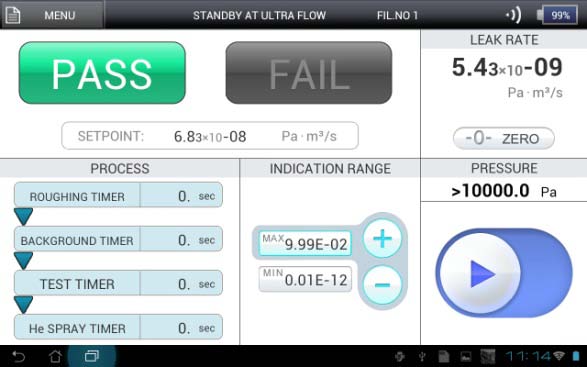
- Monitor the HELIOT display for leak rate signal.
- Localise leaks by probing small areas at a time with directed helium spray.
Three Sub-Modes (HELIOT 900 Series)
| Mode | Max inlet pressure | He pumping speed | Best sensitivity |
|---|---|---|---|
| ULTRA flow | <2 Pa (0.02 mbar) | 5 L/s | <5×10⁻¹³ Pa·m³/s |
| FINE flow | <100 Pa (1 mbar) | 1 L/s | ~10⁻¹² Pa·m³/s |
| GROSS flow | <1,200 Pa (12 mbar) | — | ~10⁻¹° Pa·m³/s |
Advantages of the Vacuum Method
- Highest sensitivity: <5×10⁻¹³ Pa·m³/s detectable in ULTRA flow mode — the most sensitive standard industrial leak testing method
- Quantitative measurement: the displayed value is the actual leak rate in Pa·m³/s (or mbar·L/s); direct comparison to acceptance criteria
- Localisation: by probing small areas of the test object surface, the exact position of a leak can be found
- Multiple leaks: all leaks in the test object contribute to the total reading; individual leaks can be localised after the total is measured
- Helium selectivity: the 90° magnetic deflection mass spectrometer responds only to mass 4 (helium) or mass 2 (hydrogen); no interference from ambient air or process gases
Applications
| Application | Typical acceptance leak rate | Recommended mode |
|---|---|---|
| Automotive fuel system components | 10⁻¹° to 10⁻¹¹ Pa·m³/s | ULTRA flow |
| Air conditioning and refrigeration (HVAC) | 10⁻¹° to 10⁻¹² Pa·m³/s | ULTRA or FINE flow |
| Vacuum vessels and chambers | 10⁻¹° to 10⁻¹² Pa·m³/s | ULTRA flow |
| Heat exchangers | 10⁻¹° to 10⁻¹² Pa·m³/s | ULTRA flow (individual tubes) |
| Semiconductor process chambers | 10⁻¹² to 10⁻¹⁴ Pa·m³/s | ULTRA flow |
| Scientific instruments | 10⁻¹³ to 10⁻¹ᯬ Pa·m³/s | ULTRA flow |
| Cryogenic equipment | 10⁻¹⁴ to 10⁻¹⁶ Pa·m³/s | ULTRA flow |
| Packaging integrity (large leak) | 10⁻⁶ to 10⁻⁹ Pa·m³/s | GROSS flow |
Requirements for the Vacuum Method
- Test object must withstand internal vacuum: the part must not collapse, deform, or be damaged when evacuated to the required inlet pressure (2 Pa for ULTRA flow, 100 Pa for FINE flow)
- Test object must be evacuable in reasonable time: very large internal volumes slow pump-down. Choose the HELIOT model with the appropriate backing pump capacity for the expected volume.
- Helium access to external surfaces: all external surfaces must be accessible for helium application. For complex geometries, a test enclosure (hood test) may be required.
- Acceptable background helium: if the work environment contains high ambient helium concentration (e.g., from nearby helium use or inadequate ventilation), background signal may interfere. Ventilate the test area.
Test Enclosure (Hood Test)
For test objects where spraying helium on individual surfaces is impractical (complex geometry, large surface area), the entire test object is enclosed in a bag, tent, or rigid hood that is filled with helium. The total integral leak rate of all leaks is measured. This method is faster for production testing but does not localise individual leaks. It is often used as a first-pass total-leakage check; an object that fails the hood test is then probed with directed spray to find the leak location.
We Provide
- On-site commissioning of HELIOT instruments for vacuum method test applications
- Test method validation support: selecting acceptance limits, test mode, and procedure for your application
- Operator training for vacuum method testing
- Preventive maintenance and calibration to maintain vacuum method test integrity
Email: mail@ulvacheliot.com
Helium Leak Testing Guide | Sniffer Method | Calibration | HELIOT 900 Series