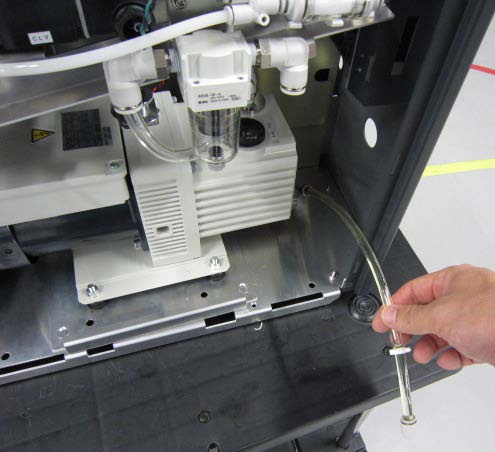
Backing Pump Service for ULVAC HELIOT Leak Detectors
The backing pump is the highest-wear component in any helium leak detector. Its condition directly determines the instrument’s pump-down speed, ultimate pressure, and ability to reach the ULTRA flow test mode. Neglected backing pumps are responsible for the majority of HELIOT performance degradation problems we diagnose. This page covers backing pump service for all ULVAC HELIOT models, with oil rotary vane and dry scroll pump specifics.
Backing Pump Types Used in HELIOT Instruments
| Pump type | HELIOT models | Key service requirement |
|---|---|---|
| Oil rotary vane pump | 901W1, 904W2, 710 series W models, 300 series, ZERO | Oil changes, gas ballast management, oil mist trap replacement |
| Dry scroll pump | 901D2, 904D3, 904D4, 710 series D models | Scroll tip seal inspection and replacement, no oil required |
Oil Rotary Vane Pump — Service Points
Oil Level and Condition
Oil level must remain within the indicated range on the sight glass. Low oil causes vane-to-stator clearance loss, reduced pumping speed, overheating, and bearing wear. More commonly overlooked is oil condition:
- Blackening: oxidation products and carbon from overheating. Change immediately.
- Milky appearance: water contamination (from pumping condensable gases without gas ballast). Drain, flush if needed, and change oil. Investigate gas ballast usage.
- Sludge at bottom: contamination from process gases or particulates. Requires pump cleaning.
- Thin/low viscosity: solvent dilution from pumping solvent vapours. Change oil, check applications.
Gas Ballast
The gas ballast valve (GBV) on the rotary pump admits a controlled amount of clean dry air or nitrogen into the compression stage, raising the effective partial pressure of condensable vapours above the saturation point so they cannot condense within the pump oil. Gas ballast use is required whenever the instrument is pumping:
- Water vapour (wet test objects, ambient humidity ingestion)
- Solvents or other condensable process gases
- During initial pump-down after long instrument storage
Gas ballast reduces the pump’s achievable ultimate pressure and should be switched off once the test object is dry and pumped to low pressure. Leaving gas ballast always open is a common service error — it prevents ULTRA flow mode operation.
Oil Mist Trap (OMT)
The oil mist trap catches pump oil aerosol carried out of the pump exhaust. A saturated oil mist trap element:
- Back-pressures the pump, reducing pumping speed
- Causes oil carry-over into the exhaust line and environment
- Can in severe cases cause oil to migrate into the HELIOT vacuum system
The 901W1 has an integrated OMT; the 904W2 may have an optional external OMT. We inspect the OMT element at every service visit and replace as required. A separate external OMT may be recommended if oil mist in the work environment is a concern.
Vane and Internal Wear Assessment
Ultimate pressure measurement is the primary indicator of vane and seal condition. Measure backing pump ultimate pressure (pump isolated from the HELIOT circuit, inlet blanked off). Compare to manufacturer’s specification for the pump model. Progressive deterioration over successive maintenance visits is more meaningful than a single reading. When pump ultimate pressure is consistently above specification after oil change and gas ballast check, internal inspection and vane replacement are indicated.
Dry Scroll Pump — Service Points
Scroll Tip Seals
Dry scroll pumps use polymer tip seals (scroll tips) that contact the opposing scroll and provide the sealing function. These wear progressively. Symptoms of worn tip seals:
- Increasing backing-pump ultimate pressure over time
- Slower pump-down at the HELIOT inlet (indirect)
- Loss of ULTRA flow mode access (system cannot reach required inlet pressure)
Tip seal replacement requires pump disassembly. Worn seals generate polymer dust inside the pump; the pump should be cleaned internally when tip seals are replaced. We perform tip seal assessments by measuring pump ultimate pressure and, where indicated, open the pump for inspection and seal replacement.
Temperature and Cooling
Dry scroll pumps operate at higher temperatures than oil rotary pumps. Overheating accelerates tip seal wear and bearing degradation. Check that the pump’s ventilation is unobstructed and the ambient temperature around the instrument is within specification (10–40°C for the HELIOT 900 series).
Particulate and Liquid Sensitivity
Dry scroll pumps are more sensitive to ingested particulates and liquids than oil pumps (oil acts as a lubricant and contamination absorber in rotary pumps). If the instrument is used in environments with particulate-generating processes or condensable gases, implement an inline filter at the pump inlet and inspect it at maintenance visits.
Consequences of Neglected Backing Pump
| Symptom | Probable cause |
|---|---|
| HELIOT cannot enter ULTRA flow mode; stops at FINE flow | Backing pump cannot achieve low enough fore-line pressure to allow TMP to reach high compression ratio |
| Slow pump-down at HELIOT inlet | Reduced backing pump capacity (worn vanes, worn tip seals, or oil condition issues) |
| TMP vibration alarm or TMP overload | Backing pump pressure too high, TMP overloaded at the fore-line |
| Oil in vacuum system | Saturated OMT, gas ballast off during wet pump-down, pump back-migration during shutdown |
| Unstable baseline / high background helium | Contaminated oil back-migrating into analysis circuit |
What We Do During Backing Pump Service
For Oil Rotary Pump Models
- Visual inspection of pump body, exhaust port, oil lines
- Oil level measurement
- Oil condition assessment (colour, viscosity, contamination)
- Oil change (ULVAC or equivalent specified oil)
- Gas ballast valve function check
- Oil mist trap element inspection; replace if saturated
- Exhaust line back-pressure check
- Pump ultimate pressure measurement (pump isolated)
- Pump noise and vibration assessment
- Check pump coupling and mounting
For Dry Scroll Pump Models
- Visual inspection of pump body and exhaust
- Operating temperature measurement
- Cooling ventilation inspection
- Pump ultimate pressure measurement (pump isolated)
- Pump noise and vibration assessment
- Inlet particulate filter inspection; replace if clogged
- Tip seal condition assessment (from ultimate pressure trend)
- Pump disassembly and internal inspection if tip seal wear indicated
- Tip seal replacement if required
- Internal cleaning after seal replacement
Request Backing Pump Service
Email: mail@ulvacheliot.com
Please include: HELIOT model, serial number, pump type (oil rotary or dry scroll), symptoms or service type required, your location. We will respond within 1–2 business days and advise the appropriate service scope and arrangement.
Preventive Maintenance | Repair | Calibration | Analyser and Ion Source Service | Spare Parts